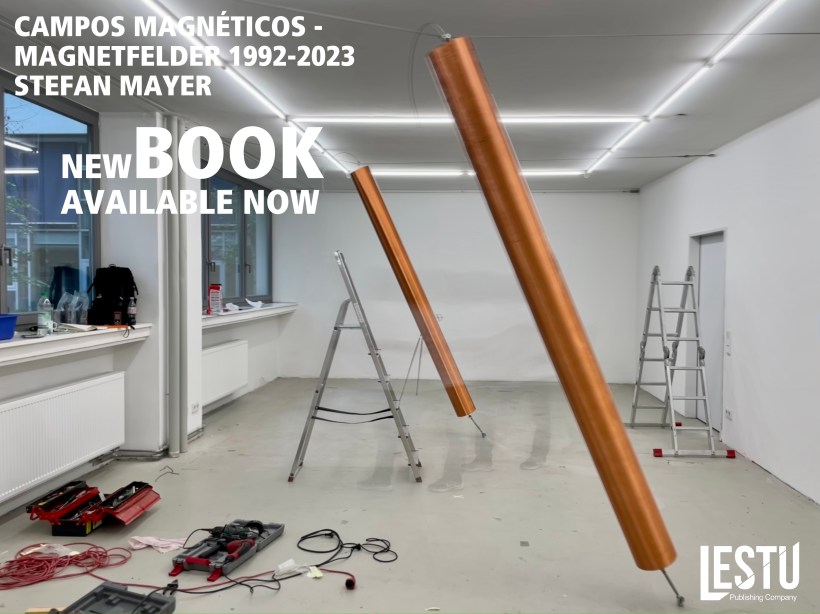
Invisible art, woven from magnetic fields, challenges the senses of human perception and is a vast new area of contemporary art to be explored. Stefan Mayer’s work exemplifies this innovation, instigating new directions for perception. In „Magnetic Fields – Magnetfelder – 1992-2023“, the latest release from Lestu (2024), Stefan Mayer brings together a collection of critical analyses of his work. Professors, journalists and artists come together to produce a fascinating exploration of this concept. Available to read and download from the publisher’s bookshop, the book invites readers to delve into this invisible universe and discover the multiple layers of meaning and perception it offers.
Stefan Mayer is an artist whose work has explored the interaction between magnetic fields and art since the 1990s, when he was still a university student. As an artist, he is dedicated to investigating how magnetic fields can be visualized and experienced in innovative ways. Mayer uses magnets and other devices to explore the Earth’s magnetic field, a phenomenon that results from the planet’s internal processes and manifests itself in various anomalies. In his works, magnetic fields are not just physical phenomena; they are elements used to create experiences that transcend sight and touch, offering a sensory dimension that demands a new mode of interaction and understanding from the viewer. Art that tests the limits of invisibility
Steyer W. Mafan says that the catalog offers an overview of a specific area of Stefan Mayer’s artistic work, which deals with the limits of visibility in different ways: „The 25 or so works and series, which span a period of more than 30 years, clearly show the various dimensions of working with magnetic fields.“ One example is the „Parasites“ series, in which objects are covered in copper wire, becoming conductors. „The properties of the winding carrier become the decisive factor for the quality and properties of the resulting field. The shape and size of the host determine the extent and strength of the field generated by the parasite (the winding),“ she says. About this project, Christiane Fricke explains that it „develops small electromagnets that need a carrier, i.e. a so-called ‚host‘, to take on their shape and therefore their function“. These parasites are installed in different locations around the world, creating temporary magnetic fields that interfere with the Earth’s natural magnetic field.
Polarities and Reflections. Exploring the theme of polarities, Christiane Meyer-Stoll points out that „polarity is an essential basic pattern of our physical and psychological experience of the world“. In the „Concentric Magnetic Field“ projects carried out in Brazil in 1992, Mayer sought to restructure the Earth’s magnetic field, determined by location. In this project, the artist redefined spatial orientation by creating concentric magnetic structures in São Paulo and Teresina, challenging the traditional perception of north and south. Meyer-Stoll observes that „the fascination emanating from the invisible force fields of the magnetic poles, beyond the visible effect of the attraction of iron, lies precisely in the contrast between matter and the immaterial effect, which makes magnetism seem predestined for a mediating role between the material and spiritual worlds“.
Investigating the variable magnetic structures, Martina Fuchs points out that, in Stefan Mayer’s work, the metal cores not only have an aesthetic function, but literally form the „centerpiece“ of the entire construction – ten permanent magnets. „Each visitor to the exhibition can determine their effect in space with the help of a simple compass, whose operation is based on the natural phenomenon of the Earth’s magnetism.“ Fuchs points out that Stefan Mayer’s intervention „Variable Magnetic Structures“ at the Straubinger Schlachthof „addresses these polarized structures, which become recognizable as global phenomena, and at the same time works subversively against them: the mobile thus exemplifies the variability and mutability of global structures.“
Field Generator Marietta Schürholz describes „Field Generator“, another project by Stefan Mayer, as an installation that „consists of a large drum with six spindles wrapped in copper wire in its center“, creating a magnetic field that „superimposes itself on the Earth’s magnetic field in a narrowly defined area and directs the field lines towards itself“. This work allows visitors to perceive the presence of invisible magnetic fields using a compass. But in „De Magnete“, Martina Fuchs notes that Mayer’s works „are not just sculptures that have an aesthetic function, but are also magnets that generate an invisible magnetic field that overlaps with the Earth’s natural magnetic field“. She points out that the exhibition combines „visible and invisible sculptures“, allowing visitors to explore the magnetic fields with the help of a compass. In another project that explores the theme of rings, „Ringfeld“, Fuchs comments that the structure is inspired by the labyrinths found in churches and creates a magnetic field that changes the orientation of the space, viewable with a compass: „and if we keep in mind that a labyrinth is an intricate system of paths that turns the entrance, exit or passage into an enigma, we could sit back and say that the aim of Stefan Mayer’s work is to remain enigmatic“.
GegenFeld – Contra Campo The installation „GegenFeld“ is the subject of Nicole Frenzel’s analysis. In this work, Mayer uses magnetic coils to reverse the orientation of the local geomagnetic field. „Even if it didn’t manifest itself visually, the stages of his artistic approach became obvious and understandable based on the elements arranged in the room.“ Frenzel points out that visitors were invited to experiment with unusual forms of perception in order to recognize and experience tangible changes in the space beyond the visible: „the effects of the intervention on the local geomagnetic field of the Projektraum were not visible to visitors. However, the objects installed indicated that a fundamental intervention had taken place in the structure of the space. Visitors were invited to experiment with unusual forms of perception in order to recognize and experience tangible changes in the space beyond the visible,“ he said.
Stefan Mayer’s work with magnetic fields exemplifies art’s ability to transcend visual and material limitations, inviting the public to explore the invisible depths of physical reality. By combining scientific and artistic elements, his works provide a profound reflection on the interaction between the natural world and human constructions, offering new ways of understanding and experiencing space and orientation
 invisible art